The Solution
Avison Young engaged Transparity to design, architect and build a new Business Rates Platform, to be hosted in the cloud.
Phase One – Scoping & Design
During the first project phase, key business requirements were agreed through a series of stakeholder workshops, and the existing platform was analysed along with the RFI requirement list. The technical architects at Transparity translated these requirements into a series of specifications for each key module of the platform.
The mission-critical ‘liability calculation engine’ requirements were captured as an exhaustive set of Behaviour Driven Design (BDD) scenarios which could be used to directly test the engine functionality during and after the implementation. The ‘Check, Challenge and Appeal’ processes were specified as a series of UML state diagrams alongside segmented swim-lane diagrams to capture systems integration points. Modules with more user exposure included detailed wireframes so Avison Young could visualise the solution.
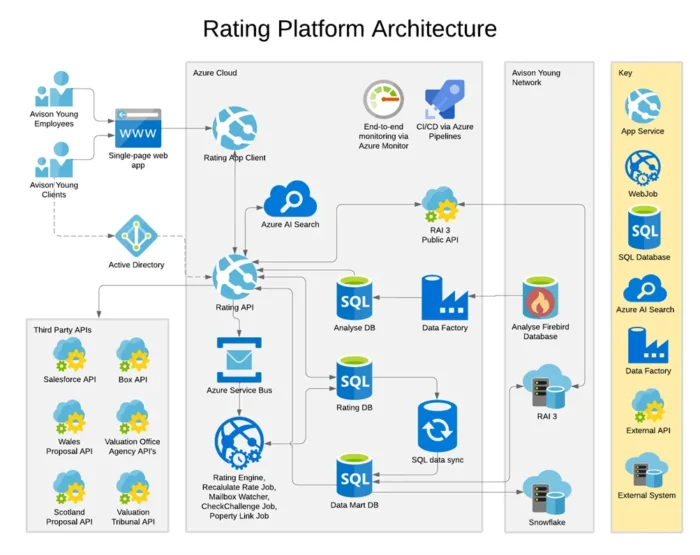
A Microsoft Azure cloud-based architecture was specified to ensure that the platform could meet the key performance and reliability conditions. Azure Service Bus was employed as an asynchronous message broker to ensure long-running processes could be handled without impacting the API or Web Client response times. Azure AI Search was leveraged to move the search function load away from the main SQL database.
Phase Two – Implementation & Testing
The second project phase moved on to system implementation and testing. A team of highly experienced software engineers and test automation engineers within the App Innovation practice at Transparity developed the platform in close collaboration with Avison Young. A set of automation tests were implemented alongside each feature to verify quality and prevent regression issues from new features added in the future. The key business stakeholders at Avison Young were kept informed at every stage to ensure that features met business requirements with clarifications immediately fed back into the iterative development life cycle.
Phase Three – Data Migration & Go Live
Following months of dedicated work and progress, the new platform was ready to go live, however, there was a final hurdle to overcome, migration of data from the legacy platform. There was no appetite to maintain and run the legacy platform in the future so all current client data needed to be migrated. Transparity developed a custom migration tool for this purpose, which handled rapid migration from multiple source databases into a single target database. The necessary schema mappings were encoded into the migration tool and existing entity relationships were maintained.